Table of Contents
ToggleWhat is Artificial Intelligence? A Complete Guide for Beginners
In the rapidly evolving landscape of the 21st century, the phrase what is artificial intelligence has transitioned from the realm of academic curiosity to a fundamental pillar of modern life. Artificial Intelligence (AI) is the driving force behind the next industrial revolution, influencing everything from global economies to our personal daily habits. To truly grasp the scope of this technology, we must look beyond the surface and understand exactly what is artificial intelligence and how it functions as a catalyst for innovation.
What is Artificial Intelligence (AI)?
At its foundational level, artificial intelligence refers to systems or machines that simulate human intelligence to perform tasks and iteratively improve themselves based on the information they collect. Unlike standard computer programs that rely on static, “if-then” logic, AI utilizes complex algorithms and massive datasets to mimic human cognitive abilities.
When analyzing what is artificial intelligence, it is important to realize it isn’t a single technology. Instead, it is an umbrella term that encompasses several sub-fields:
Machine Learning (ML): The ability of a system to learn from data without being explicitly programmed.
Deep Learning: A subset of ML that uses neural networks to solve highly complex problems, such as recognizing a human face among millions.
Natural Language Processing (NLP): Allowing machines to understand and respond to human language in a way that feels natural.
In simple terms: AI = Data Analysis + Pattern Recognition + Decision Making
In simple terms: AI = Learning + Thinking + Decision Making
To learn more about the technical foundations, you can explore IBM’s guide on AI for an in-depth look.
Real-Life Examples of AI in Action
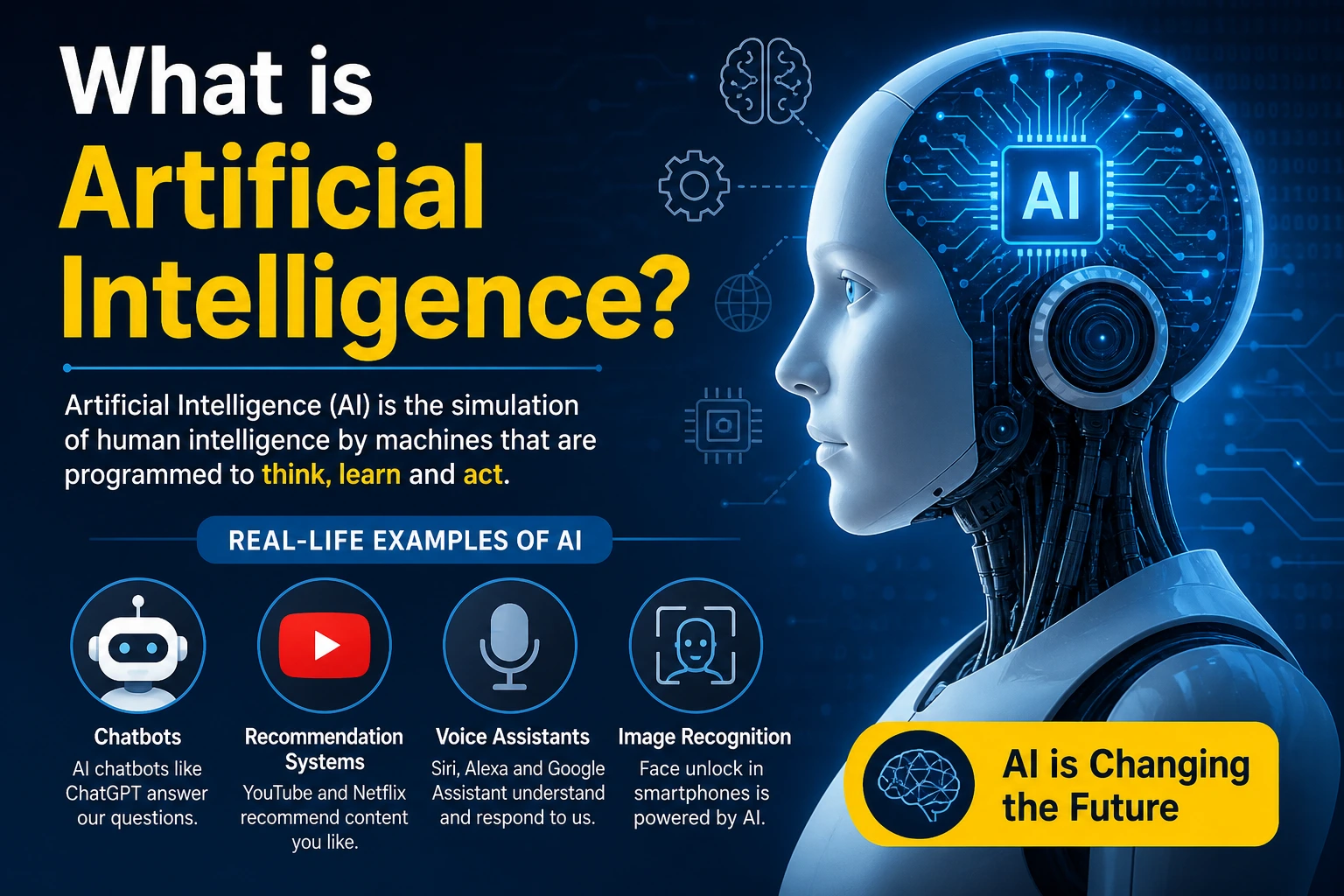
The best way to explain what is artificial intelligence to a beginner is through the tools they use every single day. AI is no longer a “future” concept; it is already working behind the scenes:
Smart Chatbots: Modern customer service relies on AI chatbots that can handle thousands of queries simultaneously, providing instant solutions that once required a human team.
Sophisticated Recommendation Systems: Whether you are on Netflix or YouTube, AI algorithms analyze your viewing history to predict what you want to watch next. This is a prime example of what is artificial intelligence achieving in personalization.
Intelligent Voice Assistants: Siri, Alexa, and Google Assistant utilize voice recognition AI to understand diverse accents and provide real-time information.
Advanced Image Recognition: From the “Face ID” on your iPhone to medical software that identifies tumors in X-rays, image recognition shows the practical power of what is artificial intelligence.
Types of Artificial Intelligence
To understand the full spectrum of what is artificial intelligence, experts categorize it into three distinct evolutionary stages:
Narrow AI (Weak AI): This is the stage we are currently in. Narrow AI is programmed to perform a single task, like playing chess or suggesting a song. It is highly efficient but lacks general consciousness.
General AI (Strong AI): This refers to a machine that possesses the ability to understand, learn, and apply its intelligence to any problem, much like a human being. This is still a work in progress in the research world.
Super AI: This is a theoretical concept where AI intelligence surpasses human capabilities across all domains, including creativity and emotional intelligence. While exciting, this remains a topic for future speculation.
Why is AI Important?
The global shift toward AI is happening because of its undeniable benefits to society and business:
Unmatched Efficiency: AI can process and analyze billions of data points in seconds, identifying trends that humans might miss.
Error Reduction: By removing human fatigue and bias from the equation, AI increases accuracy in fields like accounting and data entry.
Task Automation: AI takes over repetitive and dangerous tasks, allowing humans to focus on more creative and strategic endeavors.
Economic Growth: Businesses that integrate what is artificial intelligence into their workflow often see a massive boost in productivity and revenue.
Challenges and Disadvantages
While the benefits are vast, a complete discussion on what is artificial intelligence must include its potential drawbacks:
Job Displacement: As machines become smarter, there is a valid concern that some manual and administrative roles may disappear.
Data Privacy: AI requires huge amounts of data to learn, which raises questions about how our personal information is stored and used.
Algorithm Bias: If the data fed into an AI is biased, the decisions made by that AI will also be unfair, which is a major ethical hurdle.
The Future of AI
The trajectory of what is artificial intelligence suggests that it will soon be as essential as electricity. We are looking at a future with personalized AI tutors for every student, AI-driven climate solutions, and fully autonomous transport systems. As we continue to innovate, the focus will shift toward creating “Ethical AI” that serves the best interests of humanity.
Is AI dangerous?
AI itself is a tool. While it isn’t inherently dangerous, the misuse of this technology can cause problems.
Is AI hard to learn?
No! Beginners can start learning what is artificial intelligence through basic concepts and online tutorials quite easily.